
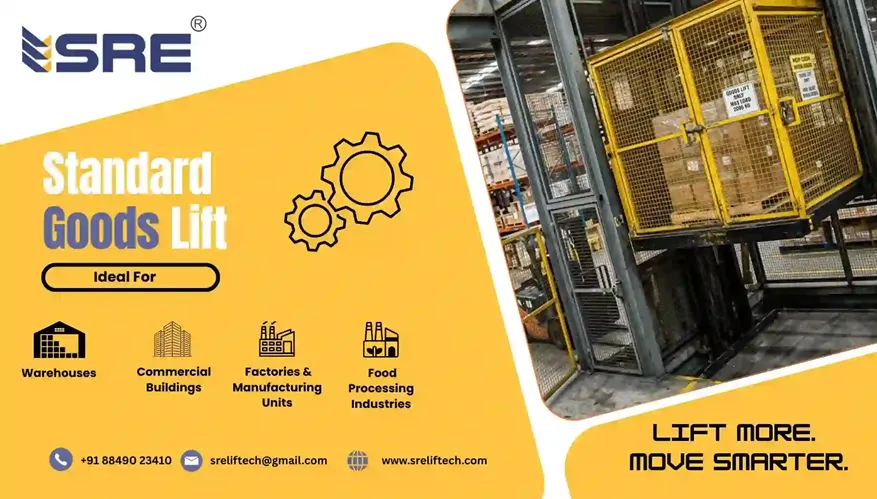
A Standard Goods Lift is one of the most practical investments a warehouse, factory, or logistics hub can make. If your team is still relying on manual trolleys, forklifts squeezed into narrow shafts, or staircases to move heavy loads between floors, this equipment can cut handling time, reduce injuries, and protect your inventory. This guide breaks down what it actually is, how it works, the sizes and capacities available in India, and how to choose the right one for your facility.
What Is a Standard Goods Lift?
A standard goods lift is a fixed, vertical material-handling machine designed to transport goods — not passengers — between different floors of a building. Unlike passenger elevators, a standard goods lift is built with a stronger platform, simpler cab design, and higher load tolerance, since it regularly carries pallets, machinery parts, raw materials, or packed cartons rather than people.
These lifts are typically powered hydraulically or mechanically and are installed in warehouses, factories, cold storage units, retail back-offices, and multi-storey industrial sheds. Because it is engineered purely for function, this equipment usually costs less to install and maintain than a passenger-rated elevator, while offering higher weight capacity per square foot of shaft space.
How Does a Standard Goods Lift Work?
Most models work on one of two operating principles:
- Hydraulic operation: A hydraulic pump pushes oil into a cylinder, and the pressure raises a piston connected to the lift platform. Lowering the lift releases the oil back into the reservoir in a controlled manner.
- Mechanical/traction operation: A motor-driven chain, rope, or rack-and-pinion system raises and lowers the platform along guide rails or a mast.
In both designs, the platform moves along a fixed mast or guide track fitted with safety rails, limit switches, and interlocking doors at every landing. Operators load the platform at ground level, select the destination floor, and the machine travels along the shaft or exposed mast to the required level. Sensors and mechanical stops ensure the platform aligns precisely with the floor before the gate opens, preventing gaps that could cause a trolley or pallet to tip.
For a closer look at how the hydraulic version of this mechanism supports high-volume operations, see this detailed piece on how hydraulic lifts improve warehouse operations.
What Capacity Can a Standard Goods Lift Handle & Standard Goods Lift Sizes?
One of the most searched questions is: what is the standard goods lift size, and how much weight can it carry? The honest answer is that there is no single universal size — every unit is manufactured to match the load, floor height, and shaft dimensions of each facility. That said, most Indian manufacturers, including SRE LIFTECH, work within the following common ranges:
| Capacity Range | Typical Platform Size (L x W) | Common Use Case |
|---|---|---|
| 500 kg – 1 Ton | 1.2m x 1.2m | Retail stockrooms, small workshops |
| 1 Ton – 3 Tons | 1.5m x 1.8m | Warehousing, printing & paper units |
| 3 Tons – 5 Tons | 2m x 2.5m | Automotive parts, engineering plants |
| 5 Tons – 10 Tons | 2.5m x 3m (custom) | Heavy engineering, industrial logistics |
At the higher end, manufacturers like SRE LIFTECH design goods lifts with a maximum capacity of up to 10 Tons, with every structural frame load-tested at 125% of rated capacity before dispatch — an important quality check that confirms the lift can safely handle occasional overloading without structural failure.
Get QuoteWhat Are the Key Features of a Standard Goods Lift?
A well-built unit is judged less by its size and more by the safety engineering built into it. Look for these features when evaluating a supplier:
- Hose-burst protection valves – stop sudden platform drops if a hydraulic hose fails.
- Overload trip valves – automatically prevent the lift from operating beyond rated capacity.
- Mechanical limit switches – stop the platform precisely at floor level, top, and bottom.
- Door safety interlocks – prevent the lift from moving unless landing doors are fully closed.
- Emergency stop buttons – give operators instant control in case of a fault.
- Safety perimeter skirts – guard against limbs or objects entering the shaft area.
- Fallback prevention safety cables – hold the platform in place even if the primary drive fails.
These are not optional extras; they are the difference between a compliant industrial lift and a liability. For a wider view of how similar safety principles apply across other lift categories, this article on standard scissor lift safety for industrial operations is a useful companion read.
Where Are Standard Goods Lifts Used?
Because the design is so adaptable, this equipment finds use across almost every heavy-industry sector in India:
- Warehousing & Logistics – moving palletised stock between storage floors quickly and safely.
- Automotive & Manufacturing – transporting components, sub-assemblies, and finished parts between production lines.
- Chemical & Pharma – fitted with flameproof motors and stainless-steel platforms for hygienic, hazard-safe environments.
- Printing & Paper – equipped with auto-leveling sensors so reams and stacks don’t shift during transit.
- Textile & Garments – lint-proof panel options reduce fire risk and contamination in fabric-heavy environments.
- Heavy Engineering – handling oversized, high-weight components between fabrication floors.
Cities with dense industrial activity — such as Ahmedabad, Rajkot, Morbi, Surat, and Vadodara — have seen strong demand for goods lifts as factories expand vertically to save floor space. If you want a closer look at how this plays out regionally, this resource on industrial hydraulic goods lifts in Ahmedabad covers local installation examples in more depth.
How to Choose the Right Standard Goods Lift?
Selecting the right one is not just about picking the highest capacity available. Consider these factors before you finalise a supplier:
- Load requirement – Calculate your heaviest expected load, then add a safety margin rather than buying at the exact limit.
- Shaft or mast space – Measure available floor-to-floor height and footprint; pit-less or pit-mounted designs may suit space-constrained sites better.
- Usage frequency – High-frequency operations need heavier-duty hydraulics and motors rated for continuous duty cycles.
- Environment – Chemical, pharma, or food-grade facilities require flameproof or stainless-steel construction.
- Certifications – Confirm the manufacturer follows ISO 9001:2015 quality management and CE compliance for build standards.
- After-sales support – A lift is only as reliable as the service network behind it; ask about response times and spare-parts availability.
- Structural testing – Ask whether the platform and frame are load-tested beyond rated capacity (ideally 125%) before installation.
Getting these details right upfront avoids costly downtime and re-engineering later.
Standard Goods Lift vs Hydraulic Goods Lift
People often use these terms interchangeably, but they describe different things — one refers to the purpose of the lift, the other to its power mechanism. Here’s a side-by-side comparison:
| Parameter | Standard Goods Lift | Hydraulic Goods Lift |
|---|---|---|
| Definition | A goods-only lift built for material transport between floors | A goods lift powered specifically by a hydraulic pump-cylinder system |
| Power Source | Can be hydraulic or mechanical/traction | Always hydraulic (oil pressure driven) |
| Speed | Moderate, application-dependent | Generally smooth and controlled, ideal for heavy loads |
| Best For | General-purpose vertical goods movement | High-capacity, low-maintenance heavy load transport |
| Maintenance | Depends on drive type chosen | Fewer moving parts in the drive train, often easier to service |
| Typical Capacity | 500 kg – 10 Tons | Up to 10 Tons (site-dependent) |
In practice, most units installed in Indian factories today use hydraulic power precisely because it offers smoother lifting, lower noise, and strong load-holding ability — which is why the two terms often overlap in real installations.
Why Choose SRE LIFTECH for Standard Goods Lifts?
SRE LIFTECH PVT LTD, based in Bakrol, Ahmedabad, designs, manufactures, and exports material handling lifts across India, with a delivery footprint covering Ahmedabad, Surat, Vadodara, Pune, and other major industrial hubs. Under the leadership of Mr. Mayur Nagar, the company has built its reputation on engineering discipline rather than shortcuts.
A few reasons industrial buyers consistently choose SRE LIFTECH:
- ISO 9001:2015 certified and CE compliant manufacturing processes.
- Capacities up to 10 Tons, suitable for everything from light warehousing to heavy engineering.
- 125% load-tested structural integrity on every unit before it leaves the factory.
- A full safety suite as standard: hose-burst protection, overload trip valves, mechanical limit switches, door safety interlocks, emergency stop buttons, safety perimeter skirts, and fallback prevention safety cables.
- A wide product range — Hydraulic Goods Lift, Standard Goods Lift, Single Mast and Dual Mast Goods Lifts, Wall Mounted Goods Lift, Pit-Less Hydraulic Goods Lift, Pit Mounted Scissor Lift, Standard Scissor Lift, Movable Scissor Lift, Electrical Scissor Lift, and Customised Scissor Lifts.
- Sector-specific engineering for warehousing, automotive, chemical & pharma, printing & paper, textile & garments, and heavy engineering.
If you’re planning a new installation or replacing an ageing goods lift, the team can walk you through load calculations, shaft design, and compliance requirements based on your specific site.
Contact SRE LIFTECH: 📍 Plot No:13, Shreenathji Industrial Estate Part -2, Bakrol Bujrang Road, Bakrol, Ahmedabad, Gujarat, India – 382430 📞 +91 88490 23410 (Calls/Enquiries) | 💬 +91 75748 85758 (WhatsApp) ✉️ sreliftech@gmail.com
Frequently Asked Questions
Q1. What is the standard goods lift size?
- There is no single fixed size — platforms typically range from 1.2m x 1.2m for light-duty use up to 2.5m x 3m or larger for heavy engineering applications, custom-built to the site and load requirement.
Q2. What is the maximum capacity of a standard goods lift?
- Capacities generally range from 500 kg to 10 Tons, depending on the drive system, platform size, and structural design.
Q3. Is a standard goods lift the same as a hydraulic goods lift?
- Not exactly. “Standard goods lift” describes the lift’s purpose (moving goods, not people), while “hydraulic goods lift” describes its power mechanism. Many standard goods lifts are hydraulically powered.
Q4. What safety certifications should a goods lift have?
- Look for ISO 9001:2015 quality certification and CE compliance, along with documented load testing — ideally at 125% of rated capacity — plus standard safety features like overload trip valves and door interlocks.
Q5. How do I choose between a goods lift and a scissor lift for my facility?
- Goods lifts are better for fixed-point, floor-to-floor movement in a shaft or mast, while scissor lifts suit lower-rise or mobile lifting needs. A supplier can assess your building layout and recommend the right fit.
Need Custom Engineering Specifications?
Consult SRE LIFTECH engineers for custom load capacities, platform dimensions, shaft drawings, and immediate B2B factory pricing.