
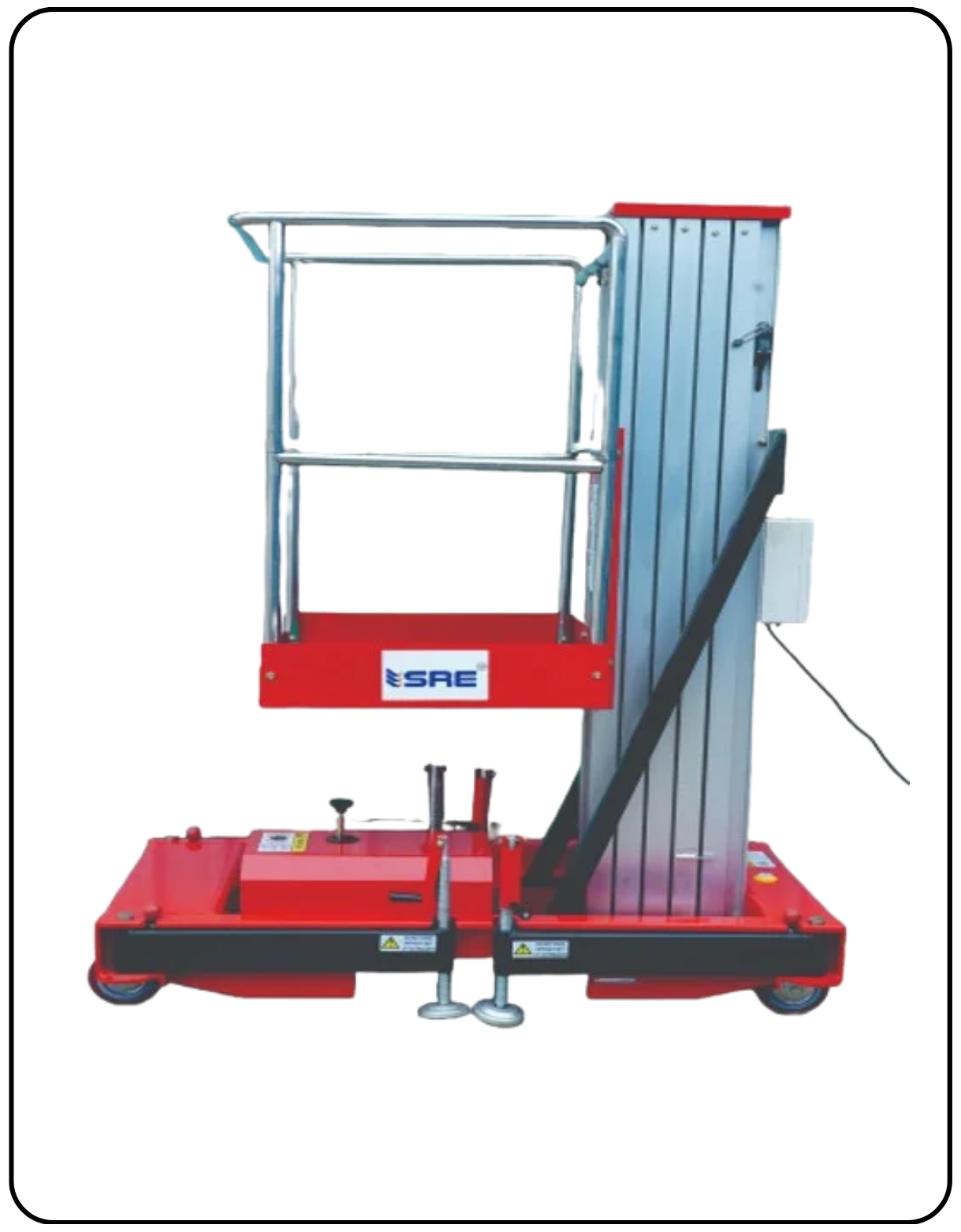
SRE Material Handling Equipment Pvt. Ltd.: Manufacturer, Supplier And Exporter Of Single Mast Aerial Work Platform in Gujarat.
SRE Material Handling Equipment Pvt. Ltd., Manufacturer And Supplier Of Single Mast Aerial Work Platform in Ahmedabad.
Our Manufacturing Unit is in Ahmedabad, Vadodara, and Rajkot, Gujarat, India.
Single Mast Aerial Work Platform in Ahmedabad: Practical Solutions for Modern Warehouses and Industries
Introduction
Warehouse and industrial operations have transformed dramatically over the past decade. Increased order volumes, tighter deadlines, and higher safety expectations have placed pressure on managers and staff alike. In daily operations, teams face challenges such as repetitive manual lifting, navigating narrow aisles, and maintaining speed without compromising safety. Fatigue, inefficiency, and minor injuries often slow down workflows.
In this evolving environment, the Single Mast Aerial Work Platform has emerged as a practical, reliable solution. Its design and functionality allow warehouses, factories, and industrial facilities in Ahmedabad to manage vertical tasks more safely and efficiently, reducing labor strain and optimizing operations.
The Changing Needs of Modern Warehouses and Industries
Modern warehouses no longer only store goods—they are high-speed operational hubs. With e-commerce growth and just-in-time delivery expectations, internal logistics teams are under constant pressure.
In daily operations, warehouse managers encounter several recurring challenges:
- Rising operational volume: Pallets, racks, and goods are moving faster than ever. Manual handling becomes a bottleneck.
- Tight deadlines: Picking, packing, and replenishment cycles leave little margin for error.
- Workforce fatigue: Repetitive lifting and climbing strain employees, leading to reduced productivity over shifts.
- Space constraints: Narrow aisles and multi-level racking demand compact and maneuverable solutions.
Addressing these challenges requires equipment that combines efficiency, safety, and ergonomic design. The Single Mast Aerial Work Platform fits this need perfectly.
What Is a Single Mast Aerial Work Platform?
In industry terms, a Single Mast Aerial Work Platform is a vertically lifting device designed to elevate personnel and lightweight materials safely to work at heights. Unlike conventional scaffolding or ladders, it provides a stable platform with controlled movement, enabling staff to perform picking, maintenance, inspection, or installation tasks efficiently.
These platforms are particularly suitable for environments with limited floor space, narrow aisles, and frequent vertical movement. They are engineered for consistent operation and can be adapted to warehouse or factory layouts without significant infrastructure changes.
Why Single Mast Aerial Work Platforms Are Replacing Traditional Manual Equipment ?
Traditional ladders and manual lifts have inherent limitations:
- Fatigue and injury risk: Repeated climbing, stretching, and lifting increase strain.
- Limited reach and stability: Reaching high shelves manually is slow and unsafe.
- Workflow inconsistency: Productivity drops during long shifts due to employee fatigue.
By comparison, a Single Mast Aerial Work Platform provides controlled vertical movement, reducing physical strain while maintaining consistent output. Daily warehouse tasks such as replenishment, order picking, and inventory checks become faster, safer, and more predictable.
Productivity Gains in Daily Operations
In warehouse operations, every minute counts. Incorporating a Single Mast Aerial Work Platform can:
- Reduce task time: Workers access high shelves directly, eliminating the need to carry items up ladders.
- Streamline multi-level picking: Consistent vertical movement allows simultaneous handling of multiple tasks.
- Maintain consistent output: Teams experience less Fatigue, ensuring productivity remains high across shifts.
For example, a factory in Ahmedabad reported smoother replenishment cycles and quicker maintenance checks after introducing single mast platforms in its narrow-aisle storage areas. These platforms help maintain pace without additional labor.
Improved Workplace Safety
Safety remains a top priority for industrial managers. Single Mast Aerial Work Platforms contribute in several practical ways:
- Controlled vertical movement: Reduces the risk of falls compared to ladders.
- Ergonomic handling: Staff operate the platform with minimal physical strain.
- Stable load support: Items are moved without the risk of tipping or dropping.
In daily operations, these features significantly lower injury incidents and create a safer working environment. Operations heads can allocate personnel to other tasks, confident that vertical access tasks are secure.
Handling Heavier Loads with Ease
Modern warehouses increasingly store bulkier goods, and manual handling becomes impractical. Single Mast Aerial Work Platforms are designed to manage moderate weights efficiently:
- Stable lift mechanisms: Ensure consistent handling of pallets, boxes, or equipment.
- Balanced design: Maintains stability while moving vertically, even in confined spaces.
- Ease of operation: Reduces risk of strain injuries when lifting items to elevated storage racks.
With controlled lifting and support, teams can manage heavier loads without sacrificing speed or safety.
Technology & Operational Efficiency
Modern single mast platforms are equipped with features that enhance uptime and reliability:
- Battery-powered options: Provide extended operation without frequent charging.
- Electric controls: Smooth vertical and horizontal movement, reducing jerks and strain.
- Mechanical simplicity: Minimizes downtime and maintenance, supporting predictable workflows.
By combining reliability and efficiency, these platforms ensure operations continue without unplanned interruptions—a critical factor in fast-paced warehouses and factories.
Space Optimization & Maneuverability
Warehouse layouts often pose challenges:
- Narrow aisles
- Dense racking
- Limited floor space
Single Mast Aerial Work Platforms are compact, allowing them to navigate tight corridors while maximizing vertical reach. Their small footprint helps maintain aisle accessibility, allowing other equipment and personnel to move freely without obstruction.
Cost Efficiency Over Time
While initial investment in a single mast platform may be higher than ladders or manual lifts, operational savings are substantial:
- Reduced workplace injuries: Fewer medical incidents translate to lower indirect costs.
- Labor efficiency: Employees complete tasks faster with less Fatigue.
- Lower downtime: Reliable machinery reduces delays in workflow.
Over time, these platforms provide measurable cost benefits, contributing to the overall ROI of warehouse operations.
Sustainability & Compliance
Industrial managers increasingly consider sustainability and compliance in equipment selection:
- Energy-efficient operation: Battery-powered or low-consumption electric models reduce energy costs.
- Clean operations: Minimal emissions and noise compared to fuel-based lifts.
- Regulatory alignment: Meets workplace safety standards, supporting compliance audits.
Integrating sustainable practices aligns operations with modern industry expectations while protecting worker health.
Integration with Warehouse / Factory Workflow
Single Mast Aerial Work Platforms can seamlessly fit into existing operations:
- Picking and replenishment: Supports high-shelf access without restructuring racks.
- Maintenance: Enables electrical, lighting, or HVAC work at height.
- Inventory checks: Quick vertical access for stock counts and inspections.
Managers can integrate platforms into warehouse management systems or operational SOPs, ensuring smooth coordination across teams.
Training, Ease of Use & Maintenance
Ease of operation is critical for adoption:
- Minimal training required: Staff can operate platforms with brief instruction sessions.
- Predictable maintenance: Simple mechanical and electrical components ensure fewer breakdowns.
- User-friendly controls: Intuitive operation reduces mistakes and learning curves.
This practicality ensures rapid deployment and consistent use without extensive operational disruption.
Why Choosing a Reliable Manufacturer Matters ?
Selecting a trustworthy manufacturer is vital to ensure equipment longevity and operational safety:
- Quality assurance: Reliable components reduce breakdowns and safety risks.
- Service support: Timely maintenance and spare parts availability minimize downtime.
- Regulatory compliance: Certified manufacturers adhere to safety standards and operational guidelines.
Industrial decision-makers should prioritize manufacturers with proven experience and strong after-sales support rather than cost alone.
Conclusion
In modern warehouses and industrial setups, managing vertical tasks efficiently and safely is crucial. The Single Mast Aerial Work Platform addresses the operational challenges of high-volume, fast-paced environments by improving productivity, reducing labor fatigue, enhancing safety, and supporting sustainable practices. For operations managers in Ahmedabad and beyond, integrating this platform offers a practical, long-term solution to streamline workflows and optimize warehouse performance.
Key Takeaways
- Productivity: Faster vertical access and consistent output across shifts.
- Safety: Reduced risk of falls and ergonomic strain.
- Load Handling: Stable support for moderate to heavy loads.
- Cost Efficiency: Long-term savings through lower labor strain, injuries, and downtime.
- Industry Trend: Modern warehouses increasingly rely on compact, efficient aerial platforms.
Trending FAQs
Q1: Can a Single Mast Aerial Work Platform fit narrow warehouse aisles?
Yes, its compact design allows safe operation in narrow spaces without obstructing other warehouse activities.
Q2: What maintenance is required?
Routine battery checks, mechanical inspections, and safety system testing are typically sufficient.
Q3: Is training required for operators?
Minimal training is needed; controls are intuitive, and operational safety guidelines are straightforward.
Q4: Can it replace traditional ladders and scaffolding?
In most cases, yes. It offers safer, faster, and more reliable vertical access.
Looking for a Single Mast Aerial Work Platform in Ahmedabad? Call +91 75728 19958 or email sremhepvtltd2025@gmail.com