
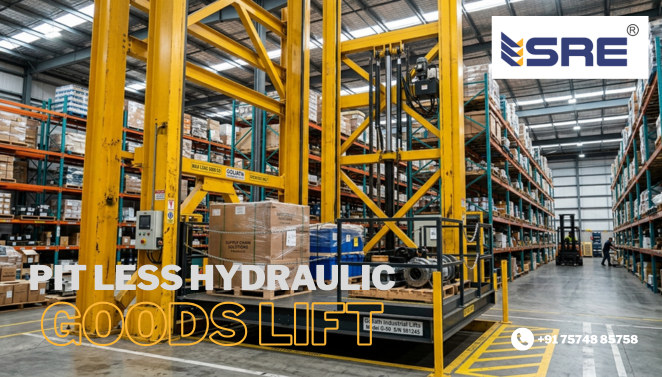
A pit mounted hydraulic goods lift is one of the most practical solutions for facilities that need reliable vertical transport of heavy goods without extensive civil work beyond a single recessed pit. Material handling operations across warehouses, factories, and logistics hubs depend on equipment that moves loads safely between floors without slowing down daily work, and this lift type has become a common choice where a flush loading surface matters. This guide explains what a pit mounted hydraulic goods lift is, how it functions, and why it suits a wide range of industrial settings.
What Is a Pit Mounted Hydraulic Goods Lift?
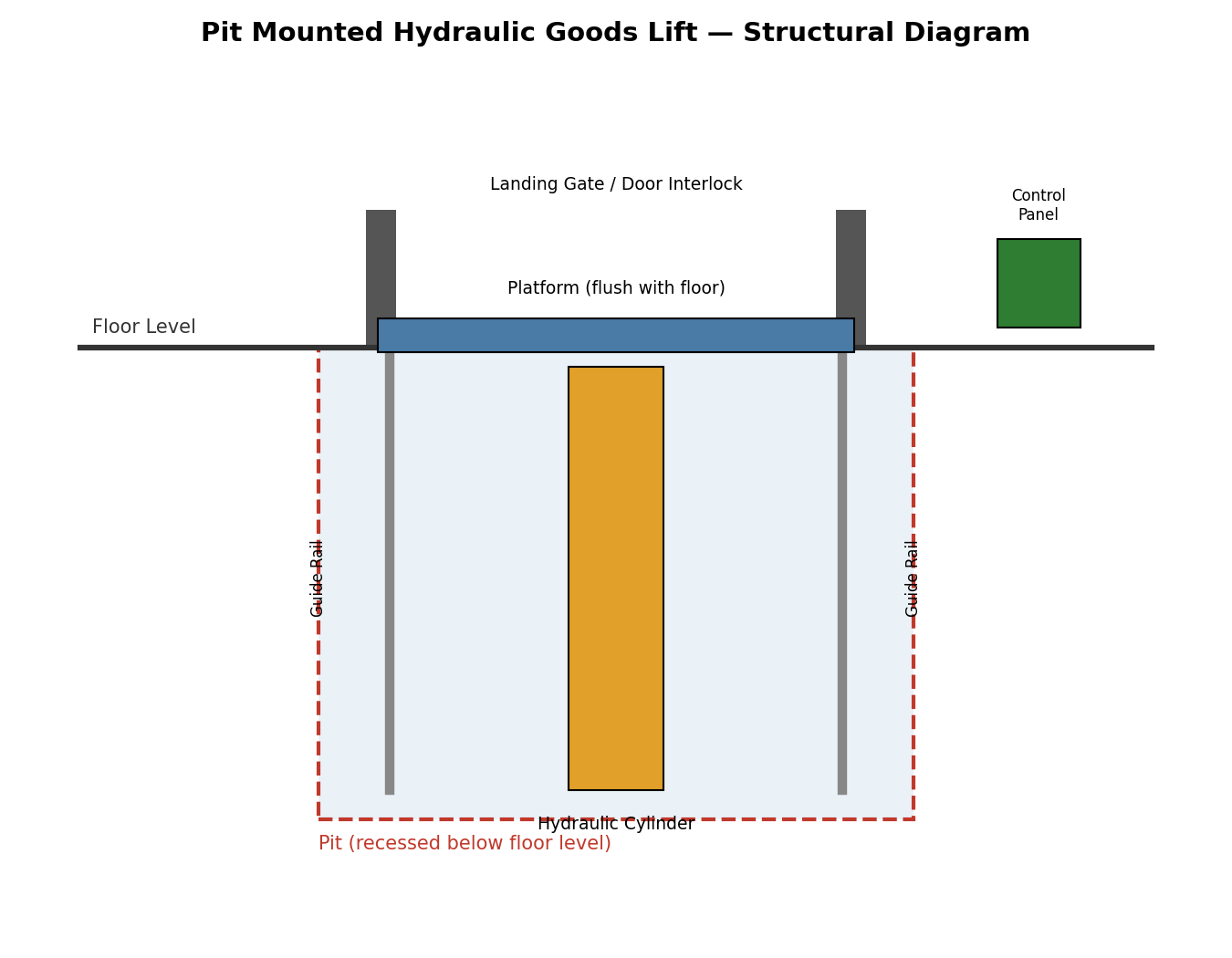
A pit mounted hydraulic goods lift is a hydraulic material handling system installed with its platform resting at floor level, supported by a shallow pit beneath the structure. Unlike a fully pit-less hydraulic goods lift that sits entirely above ground, the pit mounted hydraulic goods lift uses a recessed base to house the hydraulic cylinder and platform mechanism, allowing the lift to sit flush with the surrounding floor when lowered.
This design is common in facilities where goods need to move between a ground floor and an upper mezzanine or storage level, and where a flush platform makes loading and unloading with trolleys or pallet jacks easier. The pit acts as a housing for the lifting mechanism, keeping the hydraulic goods lift compact while still supporting heavy loads.
How Does a Pit Mounted Hydraulic Goods Lift Work?
The lift operates on a hydraulic power pack that drives a cylinder connected to the platform. When the operator activates the system, hydraulic fluid is pumped into the cylinder, raising the platform along guide rails fixed to the lift structure. Lowering the platform reverses this process, releasing fluid pressure in a controlled manner so the descent stays smooth.
Because the pit houses part of the mechanism, the platform can align with the floor surface at the lowest position, removing the need for a ramp. Most goods lift machine designs of this type include a control panel with call buttons at each landing, allowing staff to operate the lift from any floor it serves. Sensors and limit switches regulate the travel distance, stopping the platform precisely at each level.
Key Features of a Pit Mounted Hydraulic Goods Lift
Several features distinguish a well-engineered pit mounted hydraulic goods lift from a basic lifting platform:
- Flush floor-level loading at the pit level, which reduces manual effort when moving goods on wheeled equipment.
- Hydraulic power unit sized according to load capacity, generally offering smooth and quiet operation compared to chain or rope-driven alternatives.
- Guide rail system that keeps the platform stable during vertical travel, even with uneven load distribution.
- Safety interlocks at each landing gate, preventing the lift from moving unless doors are properly closed.
- Overload protection valves that stop the lift from operating beyond its rated capacity.
- Customisable platform sizes to match pallet dimensions, trolley widths, or specific product handling needs.
These features are largely consistent across pit mounted hydraulic scissor lift and pit mounted scissor lift table configurations, though scissor-style lifts use a folding arm mechanism instead of a straight vertical rail.
Benefits of Using a Pit Mounted Hydraulic Goods Lift
Facilities that adopt a pit mounted hydraulic goods lift typically report a few recurring advantages:
Smoother material flow between floors. A flush platform at ground level means staff can push loaded trolleys directly onto the lift without lifting them over a ledge or ramp, which reduces strain and the time spent per transfer.
Lower long-term maintenance compared to fully mechanical lifts. Hydraulic systems have fewer moving parts exposed to wear than chain-and-sprocket designs, and servicing is generally limited to fluid checks, seal inspection, and periodic valve testing. For a broader look at throughput gains, see How Goods Lifts Improve Warehouse Efficiency.
Space efficiency. Because the pit absorbs part of the structure, the lift does not require as much overhead clearance as some other goods lift machine types, which is useful in buildings with limited ceiling height.
Adaptability to heavy loads. Hydraulic goods lift systems can be engineered for capacities ranging from a few hundred kilograms up to several tons, making them suitable for both light-duty document and stock movement and heavy industrial material handling lift applications.
Consistent safety performance when properly certified. Lifts built and load-tested according to recognised standards, such as ISO 9001:2015, tend to hold their structural performance over years of continuous use, provided routine maintenance schedules are followed.
How to Choose the Right Pit Mounted Hydraulic Goods Lift
Selecting a pit mounted hydraulic goods lift involves matching the equipment to the specific demands of a facility rather than picking a standard size. The following factors are worth evaluating before finalising a design.
Load Capacity
The maximum weight the lift will carry, including any dynamic loading from moving trolleys or forklifts, needs to be confirmed upfront. Underestimating capacity requirements is one of the more common planning mistakes, since future expansion of stock volumes often increases the load per trip.
Platform Size
Platform dimensions should accommodate the largest pallet, crate, or trolley expected to use the lift, with enough margin for safe manoeuvring. A platform that is too small forces staff to split loads, which slows down operations.
Lifting Height
The vertical distance between floors determines cylinder length and the overall structural design. Multi-floor buildings may require a two-stage or telescopic cylinder arrangement to keep the pit depth manageable.
Pit Dimensions
Since the lift depends on a recessed pit, civil work must be planned around the site’s existing floor slab and drainage. Pit depth, width, and waterproofing all affect installation timelines and cost.
Safety Features
Buyers should confirm which safety mechanisms are included as standard, such as hose-burst protection valves, mechanical limit switches, emergency stop buttons, safety perimeter skirts, overload trip valves, door safety interlocks, and fallback prevention safety cables. These components directly affect how the lift performs under fault conditions, and align with general material-handling safety practice outlined in OSHA 1910.176.
Installation Requirements
Site access, power supply, and floor load-bearing capacity all influence installation. It helps to involve the manufacturer’s engineering team early so the pit design matches the hydraulic unit being supplied.
| Factor | What to Check | Why It Matters |
|---|---|---|
| Load Capacity | Maximum static and dynamic load, including trolleys or forklifts | Undersizing leads to premature wear or overload trips |
| Platform Size | Largest pallet, crate, or trolley footprint | Prevents split loads and slower cycle times |
| Lifting Height | Vertical distance between floors served | Determines cylinder type (single vs telescopic) |
| Pit Dimensions | Depth, width, and drainage of the pit | Affects civil work cost and installation timeline |
| Safety Features | Hose-burst valves, interlocks, overload trips, limit switches | Directly affects performance under fault conditions |
| Installation Site | Power supply, access, floor load-bearing capacity | Impacts feasibility and installation schedule |
Applications of Pit Mounted Hydraulic Goods Lifts
A pit mounted hydraulic goods lift for industrial use appears across several sectors:
- Warehousing and logistics: moving palletised goods between storage floors and dispatch areas, where a pit mounted goods lift for material handling keeps throughput steady during peak periods.
- Automotive and manufacturing: transporting components and sub-assemblies between production lines on different levels.
- Chemical and pharmaceutical facilities: where flameproof motors and stainless steel platforms are often specified to meet hygiene and safety requirements.
- Printing and paper stacking operations: where auto-levelling sensors help keep stacked reels or paper bundles stable during transit.
- Textile and garment units: where lint-proof panel enclosures reduce contamination risk around fabric handling.
- Heavy engineering plants: where higher-capacity hydraulic goods lift systems handle metal stock, tooling, or finished parts.
Facilities running multi-level warehouses often pair this lift type with a Dual Mast Goods Lift for Warehouse setup to handle higher throughput across several floors simultaneously.
A pit mounted hydraulic goods lift for warehouses in particular benefits from the flush platform design, since forklifts and pallet trucks can enter and exit without needing a transition ramp.
Pit Mounted Hydraulic Goods Lift vs Other Goods Lifts
Compared with a standard goods lift or a wall mounted goods lift, the pit mounted design offers a flush loading surface but requires more upfront civil work for the pit itself. A single mast goods lift or dual mast goods lift, by contrast, typically sits above floor level and may need a ramp or a raised loading dock. Scissor lift with pit configurations sit somewhere between the two, using a pit for the lift’s mechanism while retaining a folding scissor arm rather than a straight hydraulic ram.
The choice between a pit for scissor lift setup, a pit mounted scissor lift table, or a standard hydraulic goods lift usually comes down to available floor space, ceiling height, and how frequently wheeled equipment needs to cross the loading surface. Facilities with limited headroom often favour the pit type, since the recessed pit absorbs some of the vertical mechanism. If floor-level access is not a priority, a Wall Mounted Goods Lift can also be a space-saving alternative worth comparing.
| Lift Type | Loading Surface | Civil Work Needed | Overhead Clearance | Typical Use Case |
|---|---|---|---|---|
| Pit Mounted Hydraulic Goods Lift | Flush with floor | Pit excavation required | Moderate to low | Warehouses needing trolley/pallet access |
| Pit-Less Hydraulic Goods Lift | Above floor (ramp needed) | Minimal | Moderate to low | Sites where excavation isn’t feasible |
| Standard/Single Mast Goods Lift | Above floor | Minimal | Higher | Light to medium duty, budget installs |
| Dual Mast Goods Lift | Above floor | Minimal | Higher | Heavier loads, multi-floor buildings |
| Wall Mounted Goods Lift | Above floor | Minimal, wall-fixed | Depends on wall height | Space-constrained sites |
Maintenance and Safety for a Pit Mounted Hydraulic Goods Lift
Routine maintenance keeps a hydraulic lift pit system operating within its designed safety margins. Typical maintenance tasks include:
- Checking hydraulic fluid levels and looking for signs of leakage around seals and hoses.
- Testing overload trip valves and hose-burst protection valves to confirm they activate correctly.
- Inspecting door safety interlocks and emergency stop buttons during scheduled downtime.
- Verifying that fallback prevention safety cables and safety perimeter skirts remain intact and correctly tensioned.
- Cleaning the pit area to prevent debris build-up, which can interfere with the platform’s guide rails.
Operators should also keep a maintenance log, since documented service history is often required during safety audits or insurance reviews for industrial material handling lift equipment.
How Much Does a Pit Mounted Hydraulic Goods Lift Cost?
Pricing for a pit mounted hydraulic goods lift depends on several variables: load capacity, platform size, lifting height, the number of floors served, the depth and complexity of pit construction, and the safety features specified. A lift built for a few hundred kilograms with a single floor rise will cost considerably less than a multi-ton, multi-floor system with stainless steel platforms and flameproof motors for pharmaceutical use.
Because pit construction involves site-specific civil work, it is difficult to quote a fixed lift machine price without a site survey. Manufacturers typically provide a cost estimate after reviewing floor plans, load requirements, and installation site conditions, along with an itemised breakdown covering the hydraulic unit, platform, safety systems, and civil work.
Why Choose SRE LIFTECH Pvt Ltd?
SRE LIFTECH PVT LTD, based in Bakrol, Ahmedabad, Gujarat, designs, manufactures, and exports material handling lifts including hydraulic goods lifts, standard goods lifts, single mast goods lifts, dual mast goods lifts, wall mounted goods lifts, pit-less hydraulic goods lifts, pit mounted scissor lifts, standard scissor lifts, movable scissor lifts, electrical scissor lifts, and customised scissor lifts.
Under the leadership of Mr. Mayur Nagar, the company’s manufacturing process is ISO 9001:2015 certified and CE compliant, with structures tested at 125% of rated load capacity before dispatch, up to a maximum capacity of 10 tons. Every unit includes the named safety components discussed above — hose-burst protection valves, mechanical limit switches, emergency stop buttons, safety perimeter skirts, overload trip valves, door safety interlocks, and fallback prevention safety cables.
SRE LIFTECH serves clients across Ahmedabad, Surat, Vadodara, Pune, and other Indian industrial hubs, with export reach extending to Rajkot, Morbi, and wider Ahmedabad-based supply chains, as well as international markets in the UAE, Africa, and Asia. As one of the goods lift manufacturers in India working across warehousing, automotive, chemical, printing, textile, and heavy engineering sectors, the company can be reached at +91 88490 23410 for calls and enquiries, +91 75748 85758 on WhatsApp, or sreliftech@gmail.com for project-specific queries.
Frequently Asked Questions
1. What is the difference between a pit mounted and a pit-less hydraulic goods lift?
- A pit mounted lift uses a recessed pit beneath the platform so it sits flush with the floor when lowered, while a pit-less hydraulic goods lift is installed entirely above floor level, avoiding civil excavation but usually requiring a ramp or raised platform for loading.
2. What load capacities are available for a pit mounted hydraulic goods lift?
- Capacities generally range from a few hundred kilograms for light-duty use up to 10 tons for heavy industrial material handling lift applications, depending on the hydraulic unit and structural design.
3. Is a pit mounted hydraulic goods lift suitable for a warehouse with limited ceiling height?
- Yes. Since part of the lifting mechanism sits within the pit, this design often needs less overhead clearance than lifts that carry all their structure above floor level, which is why it is a common choice for a pit mounted hydraulic goods lift for warehouses.
4. What safety certifications should a hydraulic goods lift carry?
- Look for ISO 9001:2015 manufacturing certification and CE compliance, along with documented load testing — ideally at 125% of the rated capacity — plus named safety mechanisms such as overload trip valves and door safety interlocks.
5. How long does installation take for a pit mounted hydraulic goods lift?
- Installation timelines depend on pit construction, site access, and the complexity of the hydraulic system, but civil work for the pit is usually the longest single step, so early coordination with the manufacturer’s engineering team helps avoid delays.
6. Can a pit mounted goods lift be customised for pharmaceutical or chemical facilities?
- Yes. Manufacturers can specify flameproof motors and stainless steel platforms to meet hygiene and safety requirements common in chemical and pharma environments.
7. Where can I find goods lift manufacturers in India for a pit mounted system?
- Several manufacturers across industrial hubs like Ahmedabad, Rajkot, and Morbi design and export pit mounted hydraulic goods lifts, with capabilities varying by capacity range, certification, and export experience.
Need Custom Engineering Specifications?
Consult SRE LIFTECH engineers for custom load capacities, platform dimensions, shaft drawings, and immediate B2B factory pricing.