
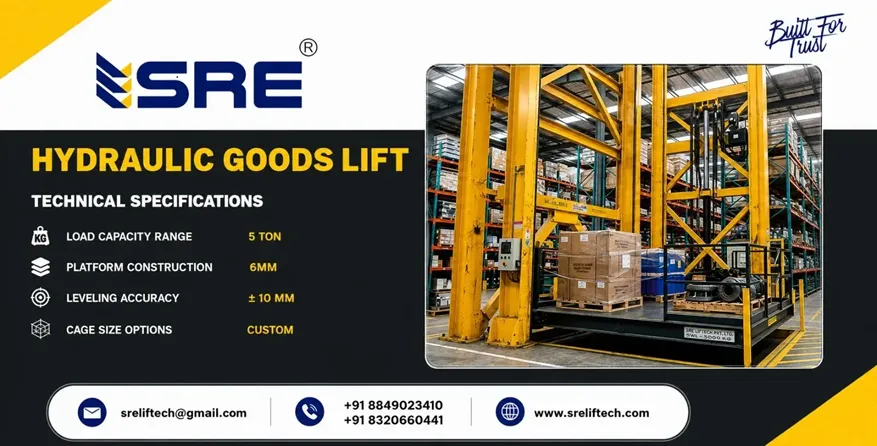
If you run a warehouse, factory, or multi-storey commercial building, moving heavy goods between floors is probably one of your biggest daily headaches. Manual lifting is slow, risky, and not something you want your workers doing eight hours a day. This is where a Hydraulic Goods Lift comes in — a simple, sturdy machine that has quietly become the backbone of Indian material handling.
This guide covers what a hydraulic goods lift actually is, how it works, where it’s used, what it costs, and how to pick the right one. Whether you’re comparing a Hydraulic Lifting Machine for the first time or upgrading your existing setup, this should answer most of your questions in one place.
What Is a Hydraulic Goods Lift
A Hydraulic Goods Lift is a type of Material Lift that uses hydraulic fluid pressure — instead of ropes, chains, or electric traction motors — to raise and lower a platform carrying heavy loads. Think of it as a mechanical elevator built specifically for goods, not passengers, though many units are also configured with safety features that allow supervised operator movement alongside the load.
Unlike a passenger elevator, a Goods Lift is built for brute strength and durability rather than speed or aesthetics. It’s designed to take repeated daily punishment — heavy pallets, machinery parts, raw material drums, printed reams, textile bales — and keep working reliably for years. That’s why so many factories, warehouses, and godowns across India rely on this simple, no-nonsense equipment rather than more complex alternatives.
How Does a Hydraulic Goods Lift Work
At its core, a hydraulic goods lift works on a very old and very reliable idea: fluid under pressure can move heavy things. A hydraulic power pack pushes oil into a cylinder, and that pressurised oil pushes a piston upward. The piston is connected to the lift platform (either directly, or through a scissor or mast mechanism), so as the piston rises, the platform rises with it.
To lower the platform, a valve simply releases the pressure in a controlled manner, letting the oil flow back into the reservoir and allowing the platform to descend smoothly. There’s no sudden drop — the flow is regulated, which is one of the reasons hydraulic systems feel so stable compared to some other lift types.
A typical setup includes a hydraulic power pack (motor, pump, oil reservoir), one or more hydraulic cylinders, a guide rail or mast structure, control valves with a control panel, and safety devices like limit switches. This is essentially the same Hydraulic Lift Working principle used across industrial equipment worldwide, just scaled and reinforced for the loads a goods lift is expected to carry.
What Is the Working Principle of a Hydraulic Lift
The working principle goes back to a basic law of physics: pressure applied to a confined fluid is transmitted equally in all directions. This is often called Pascal’s Law, and it’s the same principle behind car brakes and hydraulic jacks — just applied at industrial scale. You can read more about the science behind this in this general explanation of hydraulics.
In practical terms, a small force applied by the pump on a small area of oil converts into a much larger force on the piston, because the piston has a larger surface area. This lets a relatively compact power pack lift several tonnes of material without needing a massive motor. It’s efficient, mechanically simple, and refined over decades of industrial use, which makes it easy to maintain and troubleshoot.
What Are the Advantages of Hydraulic Goods Lift
There’s a reason a Hydraulic Lifting Machine remains the go-to choice for so many Indian manufacturers and warehouse operators. Some of the biggest advantages include:
- High load capacity – Hydraulic systems handle heavy, concentrated loads well, with capacities commonly going up to 10 tons in industrial models.
- Smooth and stable movement – No jerks during lifting or lowering, which protects both the goods and the machine.
- Lower upfront cost – Compared to traction-based systems of similar capacity, hydraulic lifts are generally more affordable to install.
- Simple mechanical design – Fewer moving parts at the top of the shaft (no overhead machine room needed in most designs), which also simplifies building layout.
- Easier maintenance – The technology is well understood, so spare parts and skilled technicians are widely available across India.
- Strong safety record – With features like hose-burst protection valves and overload trip valves, hydraulic systems fail in a controlled, predictable way rather than dropping suddenly.
Of course, no equipment is perfect for every situation, and later in this guide we compare hydraulic lifts against traction-based alternatives so you can judge what fits your operation best.
Get QuoteWhere Are Hydraulic Goods Lifts Used
An Industrial Hydraulic Lift isn’t limited to one type of business — its ruggedness makes it useful anywhere heavy goods need to move between levels:
- Warehousing & logistics – moving palletised goods between storage floors and loading docks. If you want a deeper look at this specific use case, this piece on how hydraulic lifts improve warehouse operations is worth a read.
- Automotive & manufacturing units – transporting components, sub-assemblies, and finished parts between production floors.
- Chemical & pharmaceutical plants – where flameproof motors and stainless-steel platforms are often used for safety and hygiene compliance.
- Printing & paper industries – handling reams and stacked paper, often paired with auto-levelling sensors for precise floor alignment.
- Textile & garment units – moving fabric rolls and finished goods, sometimes with lint-proof panelling to keep the mechanism clean.
- Heavy engineering workshops – shifting large metal components and machinery parts that would be unsafe to carry manually.
Given this range, it’s easy to see why demand keeps growing steadily across industrial hubs like Ahmedabad, Surat, Vadodara, and Pune.
How Much Does a Hydraulic Goods Lift Cost
This is usually the first question buyers ask, and the honest answer is: it depends. Hydraulic Goods Lift Price in India varies based on a handful of key factors:
- Load capacity (a 1-ton lift will obviously cost less than a 10-ton one)
- Lifting height/number of floors
- Mast configuration — single mast vs dual mast
- Platform size and material (mild steel vs stainless steel)
- Additional safety features and automation
- Whether it’s a pit-mounted or pit-less design
- Installation and civil work requirements at your site
Rather than quoting a single figure that may not apply to your project, it’s better to share your load, height, and application details with a manufacturer and get a quotation based on your exact requirement. Prices range from a modest investment for a light-duty single mast unit to a much higher figure for a heavy-duty, multi-floor, dual mast system.
How to Choose the Right Hydraulic Goods Lift
Picking the right lift is about matching the machine to how your business actually operates:
- Calculate your real load requirement, including future growth, not just today’s needs.
- Decide between single mast and dual mast designs. A single mast goods lift suits lighter, space-constrained setups, while dual mast units offer better stability for heavier or taller applications.
- Check whether you need a pit or pit-less design, based on your building’s civil structure and excavation budget.
- Match the platform material to your industry — stainless steel for pharma/food, mild steel for general goods.
- Confirm the safety features — overload trip valves, door interlocks, emergency stops, and fallback prevention cables should be non-negotiable.
- Ask about certifications, such as ISO 9001:2015 and CE compliance, and whether the structure is load-tested beyond its rated capacity.
- Consider after-sales service — spare parts and technician availability in your region matter more than people realise until something breaks down.
If unsure which configuration fits, a standard goods lift is usually a safe, versatile starting point for general warehousing and manufacturing needs.
Hydraulic Goods Lift vs Traction Goods Lift: A Quick Comparison
| Parameter | Hydraulic Goods Lift | Traction (Electric) Goods Lift |
|---|---|---|
| Initial Cost | Generally lower | Generally higher |
| Load Handling | Excellent for heavy, high-capacity loads | Better suited to moderate loads |
| Speed | Moderate, steady movement | Faster movement |
| Machine Room | Usually not required overhead | Often requires overhead machine room |
| Maintenance | Simple, widely available expertise | Requires specialised technicians |
| Power Consumption | Higher during lifting only | More consistent, generally efficient |
| Best For | Warehousing, heavy industrial loads | Multi-storey buildings with frequent, lighter use |
At-a-Glance: Hydraulic Goods Lift Specifications
| Feature | Typical Specification |
|---|---|
| Maximum Load Capacity | Up to 10 Tons |
| Structural Testing | Tested at 125% of rated capacity |
| Certifications | ISO 9001:2015, CE Compliant |
| Safety Devices | Hose-burst protection, overload trip valves, door interlocks, emergency stop |
| Platform Options | Mild steel, stainless steel (pharma/food grade) |
| Configurations | Single mast, dual mast, wall-mounted, pit-less |
What Maintenance Does a Hydraulic Goods Lift Need
One underrated benefit of hydraulic systems is how manageable their maintenance is. A basic upkeep routine typically includes regular oil level checks and periodic oil replacement, inspection of hoses and seals for leaks or wear, scheduled testing of safety devices like limit switches and overload valves, lubrication of guide rails, and periodic load testing to confirm the structure still performs safely under rated capacity.
Most manufacturers recommend a quarterly or half-yearly check depending on usage intensity. A well-maintained hydraulic goods lift can run reliably for well over a decade, which is part of why its total cost of ownership often works out favourably compared to more complex lifting systems.
Why Choose SRE LIFTECH for Hydraulic Goods Lifts
SRE LIFTECH PVT LTD, based in Bakrol, Ahmedabad, Gujarat, has built its reputation on designing, manufacturing, and exporting high-load material handling lifts for Indian and international industries. Under the leadership of Mr. Mayur Nagar, the company focuses on getting the engineering fundamentals right — every unit is structurally tested at 125% of its rated load capacity before it leaves the factory.
The product range covers Hydraulic Goods Lift, Standard Goods Lift, Single Mast and Dual Mast Goods Lift, Wall Mounted Goods Lift, and Pit-Less Hydraulic Goods Lift, along with pit-mounted, standard, movable, electrical, and customised scissor lifts — with capacities up to 10 Tons. For a closer look at manufacturing standards, see this overview of industrial hydraulic goods lifts in Ahmedabad.
If you’re evaluating a hydraulic goods lift for your facility, it’s worth discussing your specific load, height, and industry requirements before finalising a specification. Reach SRE LIFTECH at +91 88490 23410, on WhatsApp at +91 75748 85758, or via email at sreliftech@gmail.com.
FAQs
1. What Is a Hydraulic Goods Lift and How Does It Work?
A Hydraulic Goods Lift is a material-handling system designed to move goods vertically between different floors. It uses hydraulic cylinders and pressure to raise and lower the lifting platform. SRE LIFTECH Hydraulic Goods Lift can handle loads up to 5 tons, making it suitable for warehouses, factories and industrial material movement.
2. What Are the Benefits of a Hydraulic Goods Lift?
A Hydraulic Goods Lift provides efficient vertical material movement while reducing manual handling. Key benefits include high load capacity, smooth lifting, reliable operation and improved workplace safety. SRE LIFTECH lifts also feature mechanical and electrical door interlocks, emergency rupture safety valves, and overload detection for safer goods handling.
3. How Much Does a Hydraulic Goods Lift Cost in India?
The cost of a Hydraulic Goods Lift in India depends on factors such as load capacity, lifting height, platform size, number of floors, installation requirements and customization. Since every industrial application can have different requirements, contact SRE LIFTECH for a customized quotation based on your project.
4. What Capacity Can a Hydraulic Goods Lift Handle?
A Hydraulic Goods Lift can be designed for different industrial load requirements. SRE LIFTECH Hydraulic Goods Lift offers capacity up to 5 tons, depending on the application and configuration. The required capacity should be selected according to the type, weight and volume of goods being transported between floors.
5. How Do You Choose the Right Hydraulic Goods Lift?
To choose the right Hydraulic Goods Lift, consider required load capacity, lifting height, platform dimensions, number of floors, operating conditions and required safety features. For example, SRE LIFTECH provides safety systems such as mechanical and electrical door interlocks, emergency rupture safety valves, and overload sensor and alarm cut-off systems.
Get QuoteNeed Custom Engineering Specifications?
Consult SRE LIFTECH engineers for custom load capacities, platform dimensions, shaft drawings, and immediate B2B factory pricing.