
SRE Material Handling Equipment Pvt. Ltd.: Manufacturer, Supplier, And Exporter Of Pit Mounted Scissor Lift Table in India.
SRE Material Handling Equipment Pvt. Ltd., Manufacturer And Supplier Of Pit Mounted Scissor Lift Table in Rajkot.
Our Manufacturing Unit is in Ahmedabad, Vadodara, and Rajkot, Gujarat, India.
Pit-Mounted Scissor Lift Tables in Rajkot: A Useful Guide for Industry Leaders
In today’s fast-paced industrial and warehousing sector, efficient operations are fundamental, not just a bonus. As storage and manufacturing spaces expand to meet growing needs, routine jobs can inadvertently cause holdups, reduce output, and add hidden labor expenses. Pressures such as increasing volumes, tight schedules, worker tiredness, and safety hazards make equipment choices more critical than ever.
A type of industrial apparatus that has gained popularity in these environments is the Pit Mounted Scissor Lift Table. In daily warehouse operations across Rajkot and surrounding areas, this tool demonstrates its value not just in theory, but through tangible gains in safety, output, and profitability.
This article examines what a Pit Mounted Scissor Lift Table entails, its relevance to contemporary industries, and how it can be integrated into actual workflows — free of exaggeration or sales speak.
Evolving Requirements of Today’s Warehouses and Industries
Industrial sites today face constant demands to maximize output with fewer resources. Order quantities across fields like automotive, consumer packaged goods, pharmaceuticals, and general merchandise continue to rise. Simultaneously, workforce expectations, regulatory standards, and competitive pressures increase the need for supreme operational performance.
In practical day-to-day workflows, these demands manifest as:
- Stoppages in loading and unloading when materials arrive on mixed pallets.
- Workstation choke points where manual lifting slows down packing or assembly processes.
- Uneven output across shifts due to varying operator strength and methods.
- Accumulated worker exhaustion results in slower task completion and increased safety risks.
For warehouse proprietors, factory supervisors, operations directors, supply chain executives, and purchasing departments, these issues are familiar — and they call for concrete solutions backed by proven performance.
What Exactly Is a Pit-Mounted Scissor Lift Table?
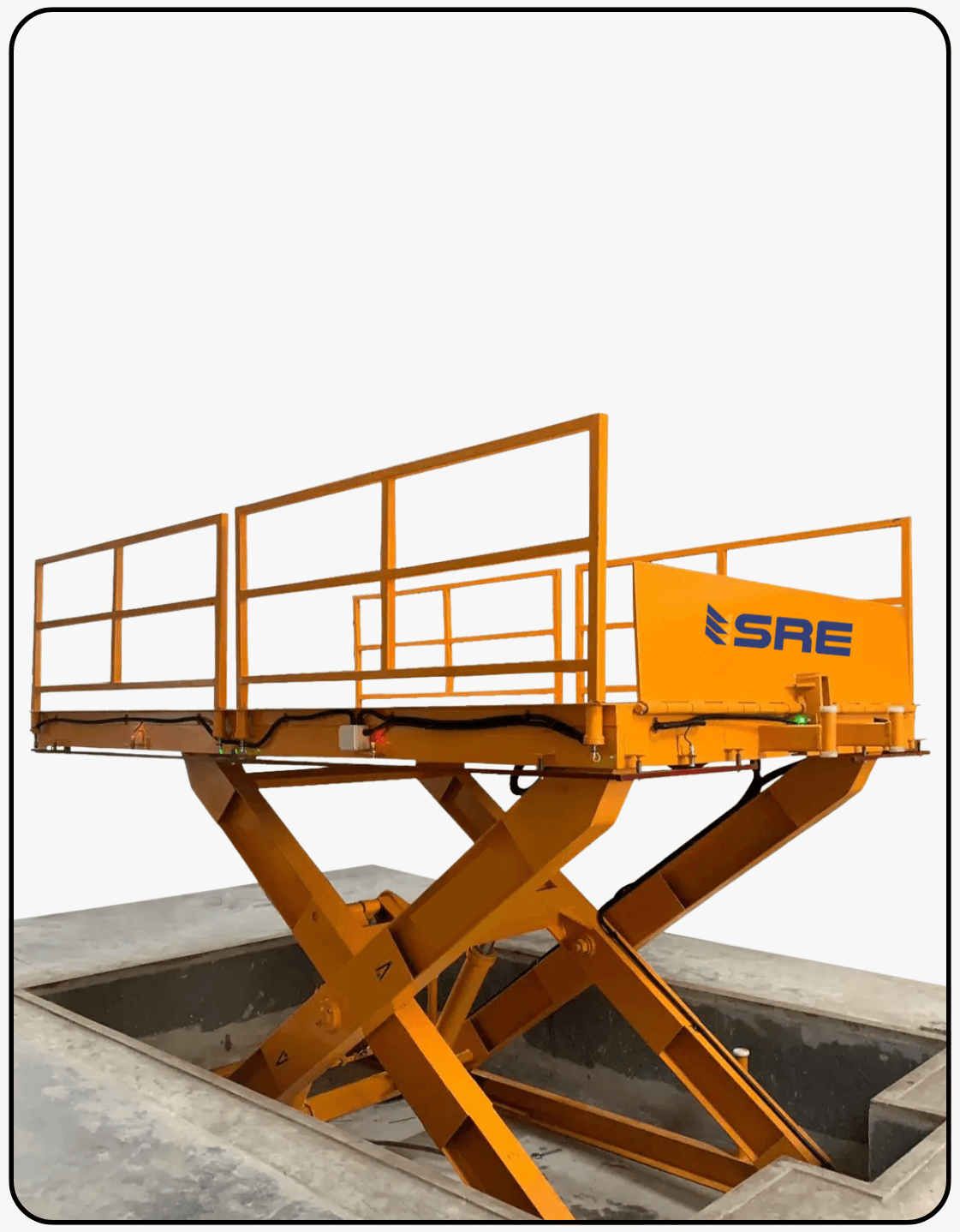
To put it simply, a Pit-Mounted Scissor Lift Table is a lifting platform installed within a floor indentation (“pit”) so that its top surface is level with the surrounding floor when fully lowered. It utilizes a scissor-like mechanism to raise or lower the platform vertically, matching the required height of loading docks, conveyor connections, or workbenches.
Unlike portable lifts or standard manual techniques, this equipment remains in a set position and provides a sturdy, powered surface that moves loads straight up and down with precise control.
Its main operational attributes include:
- Vertical movement exclusively—no horizontal travel.
- Floor-level entry at its lowest point for effortless rolling on and off of pallets and trolleys.
- Hydraulic or electric actuation for fluid, managed motion.
In routine tasks, this translates to less hands-on lifting, reduced worker strain, and better synchronization with preceding and subsequent processes.
Why Pit-Mounted Scissor Lift Tables Are Superseding Older/Manual Equipment
Modern warehouses have historically depended on manual lifting, ground-level ramps, and fixed loading docks. While these approaches have their utility, they possess well-documented limitations:
- Strain from manual lifting: Workers fatigue quickly, especially with heavier items or repetitive lifts.
- Variable handling performance: Human lifting capacity varies across shifts, leading to fluctuations in output.
- Safety hazards: Makeshift loading approaches and awkward reaching contribute to injury statistics.
Conversely, a Pit-Mounted Scissor Lift Table introduces reliability and mechanical leverage into daily operations.
Less Fatigue, More Consistent Performance
When operators are relieved of the constant lifting of heavy objects, fatigue decreases, and consistent output is achieved. In actual warehouse environments, this can translate to:
- Faster unloading of incoming freight.
- Quicker material transfers to packing or sorting areas.
- Standardized handling, irrespective of who is operating the machinery.
Superior Efficiency Compared to Manual Options
A powered lift table does more than minimize exertion — it reduces the time per cycle. Standard manual pallet jacks may necessitate repositioning, walking back and forth, and extra steps in handling. A pit-mounted scissor lift handles these adjustments in place, reducing unnecessary movements.
Productivity Increases in Everyday Tasks
Productivity benefits from a Pit Mounted Scissor Lift Table might seem minor initially, but they accumulate over time.
Time Savings
Instead of manually adjusting pallets to match workstation heights, the lift table lets teams bring materials to the optimal ergonomic level instantly. In a distribution center, this can shave minutes off each docking or staging activity — a significant amount when multiplied across several cycles per shift.
Steady Output Across Shifts
Operational uniformity is vital. When every shift has access to a dependable lifting mechanism, results become more predictable. This aids in superior scheduling, accurate volume projections, and fewer last-minute scrambles.
Enhanced Flow at Connection Points
In many facilities, workflow slows near loading bays and transfer locations between different pieces of equipment. A Pit Mounted Scissor Lift Table can act as a balancing element, matching load heights between:
- Vehicles and dock floors
- Conveyor systems and work areas
- Storage rack levels and staging zones
This matching reduces waiting periods and handling complexity — improving overall movement.
Better Workplace Safety
Safety is not just about meeting rules — it’s about safeguarding personnel, avoiding operational stops, and fostering work environments where employees can perform optimally.
Injury Mitigation Through Ergonomics
Lifting, lowering, and placing heavy goods manually burdens the back, shoulders, and knees. Over the course of a workweek, this accumulated stress can lead to musculoskeletal issues.
A Pit Mounted Scissor Lift Table significantly lessens these strains by:
- Eliminating awkward lifting stances.
- Allowing operators to work at a convenient waist height.
- Decreasing the number of manual hand-offs between personnel.
Controlled Movement, Reliable Operations
Unlike ramps or forklift-assisted lifting, powered scissor tables move vertically at a controlled pace and with stability. This predictability helps guard against dropped cargo, shifts in balance, or sudden movements that can trigger accidents.
Practically speaking, facilities adopting mechanized lifting see fewer minor incident reports, fewer overtime requirements due to injuries, and greater staff confidence when performing recurring tasks.
Handling Heavier Loads More Easily
Modern warehouses increasingly handle heavier, more diverse product weights. Bulk shipments, consolidated pallets, and significant components are becoming more common across sectors such as automotive, industrial supplies, and e-commerce.
Manual equipment has apparent limitations. Beyond certain weights, hand trucks, pallet jacks, and ramps are not safe or effective.
Stability and Control
Pit-mounted scissor Lift Tables provide:
- High load capacities customized for specific uses.
- Stable platforms that prevent load tilting or imbalance.
- Simple alignment with conveyors or workbenches.
This reduces reliance on forklifts for positioning loads at intermediate heights, cutting down on idle time and avoiding unnecessary equipment travel.
Lowering the Need for Extra Handling Steps
By delivering goods directly to the correct elevation, lift tables decrease the necessity for intermediate transfers. This streamlines processes, reduces the potential for damage, and accelerates overall cycle times.
Machine Performance and Operational Smoothness
Not every lifting platform is built the same. Contemporary Pit-Mounted Scissor Lift Tables feature capabilities that meet the uptime and reliability needs of industrial settings.
Power and Command Systems
Whether driven by durable hydraulic mechanisms or precise electronic actuators, these lifting units are engineered for fluid movement under weight. This translates to tangible daily benefits:
- Quicker reaction times
- Enhanced consistency across repetitions
- Reduced servicing needs versus makeshift solutions
Minimized Out-of-Service Time
Industrial settings rely on equipment that remains operational. These lift tables are constructed for demanding usage patterns and scheduled servicing, resulting in fewer unforeseen stoppages.
Consistent availability directly bolsters production timelines, shift output, and adherence to service agreements.
Efficient Space Utilization and Agility
Floor space within facilities — notably in areas like Rajkot where industrial real estate is valued — demands careful management.
Small Footprints
Unlike free-standing hoists or bulky loading bay apparatus, a pit‑mounted scissor unit occupies a defined, modest area. When set flush with the ground, it avoids:
- Obstructing thoroughfares
- Needing supplementary preparation zones
- Demanding dedicated forklift staging sectors
Improved Fit for Constrained Aisles
In workplaces structured with tight aisle configurations, every square unit matters. A Pit-Mounted Scissor Lift Table can be positioned to facilitate crucial transfer points without blocking main movement channels.
This enhances both operational flow and worker security by lessening crowding.
Long-Term Fiscal Smartness
Expense considerations for industrial assets should extend beyond the initial purchase price. A more valuable assessment focuses on the overall cost of ownership.
Decreased Personnel Expenditure
By minimizing manual lifting and repositioning, these lift platforms reduce the effort required for key activities. Over the span of a year, even slight gains in cycle efficiency can translate into reduced surplus hours and better deployment of existing personnel.
Lowered Costs Related to Workplace Incidents
Workplace mishaps incur both visible and hidden expenditures, including:
- Healthcare expenditures
- Lost output
- Insurance payments
Reassignment of job functions
Investing in mechanized lifting assistance, such as a Pit-Mounted Scissor Lift Table, can mitigate these costs.
Durability and Dependability
Designed for industrial-duty cycles and heavier loads, high-quality units offer extended operational lifetimes. With standard preventative upkeep, they can remain integral to operations for many years.
Environmental Responsibility and Regulatory Adherence
While equipment sustainability is often framed around energy conservation, its scope here is broader:
- Cleaner processes with less hands-on involvement.
- Reduced exhaust from less forklift usage.
- Adherence to ergonomic guidelines stipulated by safety bodies.
Facilities that demonstrate proactive ergonomic strategies often experience smoother external inspections and stronger organizational safety cultures.
Incorporation Into Site and Production Flow
A Pit-Mounted Scissor Lift Table is more than an isolated piece of hardware. Its real worth is realized when woven into established operational routines.
Workflow Intersections
These mechanisms can serve as focal points for:
- Transfers from receiving docks to production lines
- Junctions connecting to conveyor systems
- Quality assessment stations
- Areas for packaging or returns sorting
By standardizing height and material movement between phases, they help eliminate recurring slowdowns.
Digital and System Interconnectivity
In advanced settings, these lift tables can sometimes be linked to warehouse organization software (WMS) or material flow oversight. Although not always essential, this capability enables synchronized operations — especially in automated settings.
Operator Familiarity, Simplicity, and Servicing
For the team running the equipment, ease of use is as vital as performance metrics.
Straightforward Operation
Pit-mounted scissor Lift Tables generally use basic control methods — push buttons, foot pedals, or built-in panel inputs. Users can usually become proficient within a single work period.
Predictable Servicing
Periodic evaluations concentrate on:
- Hydraulic or electrical drive apparatus
- Structural soundness
- Safety parameters and controls
When incorporated into routine preventive maintenance schedules, these evaluations ensure consistent, reliable performance.
The Importance of Selecting a Reputable Producer
Not all lift tables offer the same value. The quality of construction, available technical help, and design expertise make a difference in real operational scenarios.
Decision-makers should assess manufacturers based on:
- Engineering prowess and verifiable industrial track record
- Availability of local technical assistance near Rajkot
- Alignment with recognized safety and quality benchmarks
- Ease of acquiring replacement components
Collaborating with seasoned industrial equipment providers helps secure the long-term viability of your asset. For examples of trusted suppliers, examine solutions from SRE MATERIAL HANDLING EQUIPMENT PRIVATE LIMITED
Summary
In the everyday running of industry — whether a busy warehouse in Rajkot or a plant processing high volumes of goods — the appropriate tools enhance output, safety, and cost efficiency.
A Pit-Mounted Scissor Lift Table won’t resolve every hurdle. Still, it addresses fundamental material-handling obstacles that impede operations and strain personnel: inconsistent lifting, ergonomic hazards, and inefficient movement paths.
For facility managers aiming to boost throughput while safeguarding individuals and reducing hidden costs, this type of lift table warrants serious consideration as part of a balanced material handling strategy.
Key Takeaways
- Productivity: Speeds up cycle times and stabilizes output across shifts.
- Safety: Improves ergonomics and reduces risks associated with manual lifting.
- Load Management: Handles heavier, more varied loads with precise control.
- Fiscal Benefit: Lowers labor and incident-related expenditures over time.
- Space Efficiency: Integrates into tight workflows without blocking movement paths.
- Compliance & Responsibility: Supports adherence to ergonomic and safety standards.
Trending FAQs
Q1. How does a Pit Mounted Scissor Lift Table improve safety in a warehouse?
A1. It positions materials at ergonomic heights, reducing the need for manual lifting and awkward body positions that cause strains and injuries.
Q2. Are Pit-Mounted Scissor Lift Tables suitable for heavy loads?
A2. Yes. They are engineered for industrial payloads and provide stable, controlled lifting even with heavy pallets or equipment.
Q3. Can these lift tables integrate with conveyor systems?
A3. Many models can be integrated with conveyors or dock systems to streamline material flow and reduce handling steps.
Q4. What maintenance do these tables require?
A4. Routine checks focus on hydraulic or electric systems and structural integrity. These are predictable and fit into standard preventive maintenance cycles.
Q5. Is the installation complex?
A5. Installation involves creating a floor pit and securely anchoring the unit. A qualified provider will handle this efficiently and align it with your workflow needs.
Contact SRE MATERIAL HANDLING EQUIPMENT PRIVATE LIMITED today. Call +91 75728 19958 or sremhepvtltd2025@gmail.com for assistance now.
#PitMountedScissorLiftTable #IndustrialEquipment #WarehouseEfficiency #MaterialHandling #SafetyFirst #ProductivityBoost #LogisticsSolutions #SREMaterialHandlingEquipmentPrivateLimited #RajkotIndustry #FactoryOperations