
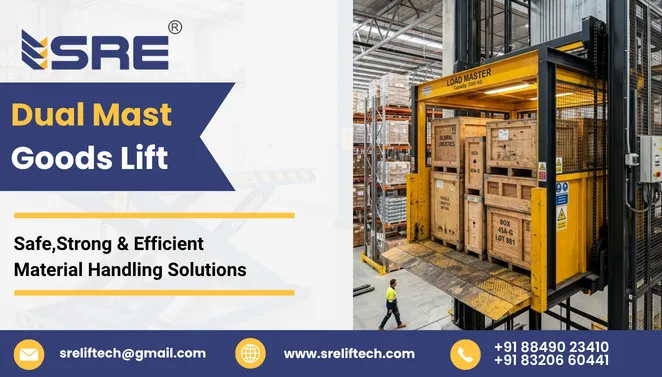
A dual mast goods lift moves heavy pallets, machinery and bulk material between floors on two rigid steel masts, driven by a hydraulic power pack. If your factory or warehouse still relies on manual carrying, ramps or an overloaded old lift, this equipment removes that bottleneck without rebuilding your building. This guide explains how the system works, what to check before buying, where it is used, how installation happens and what decides the price.
What Is a Dual Mast Goods Lift and How Does It Work?
A dual mast goods lift is an industrial goods lift built around two vertical steel masts placed on either side of the platform. The masts act as guide columns. The platform travels along them on rollers or guide shoes, while hydraulic cylinders push it up and let it down under controlled oil pressure.
Because the load is shared between two masts, the platform stays level even when cargo is heavy or slightly off-centre. A single mast design carries the load on one side, so it suits lighter, more predictable duties. Twin-mast construction spreads the stress across a wider frame, which is why it is preferred for drums, dies, rolls, pallets and machine parts.
A typical working cycle looks like this:
- The operator presses the call or up button on the control panel.
- The electric motor starts the hydraulic pump, and oil flows into the cylinder.
- The platform rises along the masts to the selected landing.
- A limit switch stops the platform, and the door interlock releases only when it is level.
- On the way down, a flow control valve lowers the platform gently, so the cargo is never dropped.
Since this is a hydraulic goods lift, it does not need a heavy counterweight or a separate machine room. That keeps civil work modest and makes the lift practical for existing buildings.
What Are the Key Features of a Dual Mast Goods Lift?
Two lifts can look identical from outside and perform very differently. These seven features separate a dependable machine from a risky one:
- Twin-mast steel structure: Heavy channels or box sections form rigid columns that resist bending and sway.
- Hydraulic drive: Smooth start and stop, with speed controlled through the valve block.
- Heavy-duty platform: Chequered mild steel for general use, or stainless steel where hygiene matters.
- High load capacity: Capacities are available up to 10 tons in customised builds.
- Layered safety systems: Hose-burst protection valves, overload trip valves, mechanical limit switches, emergency stop buttons, door safety interlocks, safety perimeter skirts and fall-prevention safety cables.
- Customisation: Platform size, travel height, door type, control panel and motor type can all be matched to the site.
- Low maintenance: Fewer moving parts than a traction system, so routine checks are mostly oil level, hoses and limit switches.
Core Components at a Glance
| Component | What It Does | Why It Matters |
|---|---|---|
| Twin masts | Guide and support the platform | Keep the platform level under load |
| Hydraulic cylinder | Lifts and lowers the platform | Delivers smooth, controlled movement |
| Power pack (motor + pump) | Generates oil pressure | Decides speed and duty cycle |
| Platform | Carries the goods | Sized to pallets, trolleys or machines |
| Hose-burst protection valve | Locks the cylinder if a hose fails | Prevents sudden drop |
| Overload trip valve | Stops lifting beyond rated load | Protects structure and operator |
| Limit switches | Set top and bottom stopping points | Avoid overtravel |
| Door interlocks | Keep landing doors locked when the platform is away | Prevent falls into the shaft |
Where Are Dual Mast Goods Lifts Used in Industries?
Wherever heavy material must move vertically on a daily schedule, this lift earns its place.
Warehousing and logistics. A dual mast goods lift for warehouse use moves loaded pallets between the ground floor and mezzanine storage without forklift ramps. It also shortens loading cycles at busy dispatch points.
Automotive and manufacturing. A dual mast goods lift for factory use carries engine blocks, dies, fabricated parts and tool kits between production levels. This keeps the assembly line supplied without stopping cranes for small jobs.
Chemical and pharma. Plants handling flammable or hygiene-sensitive material use flameproof motors and stainless steel platforms, so the lift matches the plant’s safety standards.
Printing and paper stacking. Paper reels and stacked sheets need a level platform. Auto-levelling sensors keep heavy stacks steady from floor to floor.
Textile and garments. Lint-proof panels protect the machinery from fibre dust, which is a common cause of hydraulic and electrical faults in these units.
Heavy engineering and ceramics. Fabrication shops, foundries and tile-manufacturing clusters such as Morbi move heavy, awkward loads that suit a twin-mast frame better than a light service lift.
Get QuoteWhat Are the Benefits of a Dual Mast Goods Lift?
Better stability. Two masts share the load, which reduces platform tilt and vibration. Goods stay put, and guide rollers wear evenly.
Higher productivity. A lift that runs all day removes the delay of waiting for cranes, trolleys or manual teams. Material reaches the next stage on schedule.
Improved workplace safety. Manual carrying up stairs is a leading cause of back injuries and dropped-load accidents. Mechanised lifting with interlocks and overload protection removes most of that risk.
Flexible sizing. Platform dimensions and travel height are set around your material, not the other way round. That avoids paying for space or capacity you never use.
Lower long-term cost. A robust hydraulic build with proper servicing runs for years with predictable upkeep, so cost per lift cycle falls steadily.
Suitable for existing buildings. Since there is no heavy counterweight arrangement, retrofit work is usually limited to the foundation, guide supports and electrical connection.
How Does Dual Mast Goods Lift Installation Work?
Dual mast goods lift installation follows a clear sequence. Skipping any stage usually shows up later as noise, drift or door faults.
- Site survey. Engineers measure floor heights, landing openings, available footprint and power supply. They also confirm the load type and daily trip count.
- Design and drawing. Platform size, mast section, cylinder capacity and safety devices are finalised and approved.
- Civil preparation. A pit or a ground-level base is prepared, depending on the design. Anchor points for the masts are marked accurately.
- Mast erection. Both masts are aligned vertically. Even a small misalignment causes roller wear, so this step is checked repeatedly.
- Platform and hydraulics. The platform is fitted, cylinders and hoses are connected, and the power pack is mounted and filled with oil.
- Electrical and safety wiring. Control panel, limit switches, interlocks and emergency stop are connected and tested one by one.
- Load testing. The lift is tested with its structural strength checked at 125% of rated capacity, then trial-run without and with load.
- Handover and training. Operators are taught loading limits, the emergency procedure and daily checks.
Good planning matters more than speed here. A lift installed on an uneven base or with poor alignment will never run as smoothly as one installed carefully.
What Factors Affect Dual Mast Goods Lift Price?
Buyers often search for the dual mast goods lift price as a single figure, but no honest number exists without your specifications. These are the factors that move the quotation:
- Rated capacity: A 2-ton lift and a 10-ton lift need very different steel sections, cylinders and power packs.
- Travel height and number of stops: More height means longer masts and more landing doors.
- Platform size: A larger platform needs a heavier frame.
- Steel grade and finish: Mild steel, painted, galvanised or stainless steel change the material cost.
- Safety and door package: Automatic doors, extra interlocks and sensors add to the cost.
- Motor and control type: Flameproof motors or PLC-based control cost more than standard arrangements.
- Civil work: A pit-mounted design needs excavation. A pit-less design needs a ramp or none at all.
- Site location and delivery: Distance, transport and installation logistics apply.
Compare quotations on specification, not on the final figure alone. A lower price often means thinner steel, fewer safety devices or no load test certificate.
How to Choose the Right Goods Lift Manufacturer in India?
It also helps to see how a supplier presents itself online. Reading independent marketing resources and tech-focused listings can show how visible and consistent a company’s web presence is, though site visits and references still carry more weight.
- Does the company hold ISO 9001:2015 certification and CE compliance?
- Is the structure load-tested above rated capacity, and can they show proof?
- Are hose-burst valves, overload trip valves and door interlocks standard, or optional extras?
- Can they customise the platform and controls for your process?
- Do they offer installation and service support in your city?
It also helps to see how a supplier presents itself online. Reading independent ranking resources and directory listings can show how visible and consistent a company’s web presence is, though site visits and references still carry more weight.
You should also compare lift types honestly. The table below shows where each design fits.
Lift Type Comparison
| Parameter | Single Mast Goods Lift | Dual Mast Goods Lift | Wall Mounted Goods Lift | Pit-Less Hydraulic Goods Lift |
|---|---|---|---|---|
| Structure | One mast | Two masts | Guided along a building wall | Ground-level base with ramp |
| Load suitability | Light to medium | Medium to heavy | Light to medium | Medium |
| Platform stability | Good for small loads | Very good, load shared | Depends on wall strength | Good |
| Building dependence | Low | Low | High, needs a strong wall | Low |
| Civil work | Moderate | Moderate | Wall reinforcement | Minimal |
| Best for | Small workshops | Factories, warehouses, heavy duty | Space-limited premises | Sites where a pit is not possible |
If your requirement is lighter, a single mast goods lift may be enough. For flexible hydraulic layouts you can also look at a hydraulic goods lift, and where digging a pit is difficult, a pit-less hydraulic goods lift is worth considering. For heavy, regular loads, the dual mast goods lift remains the more stable choice.
Why Choose Us for Goods Lift
SRE LIFTECH PVT LTD designs, manufactures and supplies high-load material handling lifts from Bakrol, Ahmedabad. The company works under the leadership of Mr. Mayur Nagar and is ISO 9001:2015 certified and CE compliant.
- Capacity up to 10 tons, with every structure tested at 125% of rated capacity.
- Named safety features on every lift: hose-burst protection valves, overload trip valves, mechanical limit switches, emergency stop buttons, door safety interlocks, safety perimeter skirts and fall-prevention safety cables.
- Industry-specific builds: flameproof motors and stainless steel platforms for chemical and pharma, lint-proof panels for textiles, auto-levelling sensors for paper stacking.
- Wide product range: hydraulic goods lifts, single and dual mast lifts, wall mounted and pit-less lifts, and pit mounted, movable, electrical and customised scissor lifts.
- Delivery across India, including Ahmedabad, Surat, Vadodara, Pune, Rajkot and Morbi.
To discuss your requirement, call +91 88490 23410 or write to sreliftech@gmail.com. You can visit the factory at Plot No: 13, Shreenathji Industrial Estate Part-2, Bakrol Bujrang Road, Bakrol, Ahmedabad, Gujarat 382430.
FAQs
1. What is a dual mast goods lift used for?
- It carries heavy goods such as pallets, machine parts, drums and stacked material between floors in factories, warehouses and workshops.
2. How is a dual mast lift different from a single mast lift?
- A dual mast lift uses two guide masts, so the load is shared and the platform stays more stable. A single mast lift suits lighter and more predictable loads.
3. What is the maximum capacity available?
- At SRE LIFTECH, capacity goes up to 10 tons, depending on platform size, travel height and structure design.
4. Is a pit always required?
- No. A pit-mounted design is common, but a pit-less arrangement with a ramp can be used where excavation is not practical.
5. Which safety features should I insist on?
- Hose-burst protection valves, overload trip valves, limit switches, door interlocks, an emergency stop and safety cables are the minimum.
6. Can the lift be customised for chemical or textile plants?
- Yes. Flameproof motors, stainless steel platforms and lint-proof panels can be added for such environments.
Conclusion
A dual mast goods lift gives factories and warehouses a stable, high-capacity way to move heavy material vertically. Choose it based on load, height, safety package and the manufacturer’s testing record, not on price alone. With the right specification and proper installation, it becomes a reliable part of daily operations for many years.
Get QuoteNeed Custom Engineering Specifications?
Request custom CAD drawings, load capacities, and instant B2B quotes.