
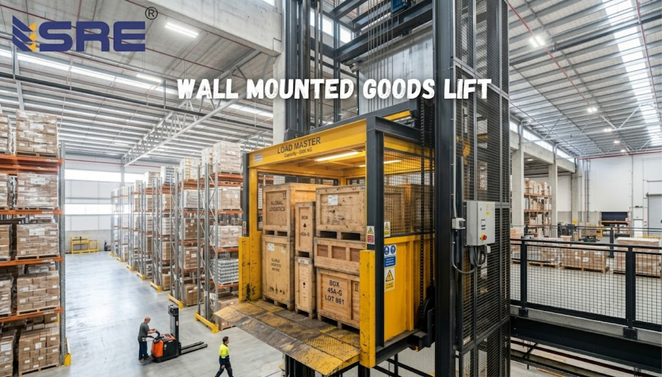
If you have ever stood in a busy warehouse and watched two workers struggle to carry a 200 kg crate up a narrow staircase, you already understand the problem a wall mounted goods lift is built to solve. It is one of those pieces of equipment that quietly does its job in the background, yet the moment it breaks down or isn’t there, an entire facility’s workflow comes to a halt.
At SRE Liftech Pvt Ltd , we design and manufacture these lifts for a living, and over the years we’ve noticed that most buyers don’t actually want a lecture on hydraulics — they want to know whether this machine will save them time, keep their team safe, and last for years without drama. So that’s exactly what this guide is about.
What Is a Wall Mounted Goods Lift?
A wall mounted goods lift is a vertical material handling system that is fixed directly to an existing wall or a supporting structural column, rather than needing a fully enclosed shaft on all four sides. Unlike a traditional passenger elevator, it is built purely to move goods — cartons, raw materials, finished products, machine parts — between floors without eating up valuable floor space.
Because the lift attaches to a wall, it’s a natural fit for buildings where space is tight or where a full lift shaft simply wasn’t part of the original construction. Most units in this category run on a “wall mounted hydraulic goods lift” mechanism, meaning a hydraulic cylinder pushes the platform up and lowers it back down smoothly, with no jerks and no sudden drops — a detail that matters a lot when you’re moving fragile or expensive inventory.
You’ll also hear this equipment called a “wall mounted stacker goods lift” in some industries, especially where it’s used to stack pallets or crates at different rack levels inside a warehouse.
Key Takeaways: Wall Mounted Goods Lift
- It saves floor space by using an existing wall as the mounting structure instead of a boxed-in shaft.
- Hydraulic models offer smoother, more controlled movement than chain or rope-driven alternatives.
- Capacities typically range from a few hundred kilograms up to several tons, depending on the application.
- Safety devices such as overload trip valves and door interlocks are essential, not optional, for compliant operation.
- It’s widely used across warehousing, manufacturing, pharma, retail back-of-house, and multi-storey industrial units.
- Buying from a manufacturer that offers real after-sales support matters more, long term, than saving a little on the upfront price.
Key Features of Wall Mounted Goods Lifts
A good wall mounted goods lift isn’t just “a platform that goes up and down.” There’s quite a bit of engineering packed into a compact footprint:
1. Hydraulic Power Pack The heart of a wall mounted hydraulic goods lift is its hydraulic power unit, which controls the lifting cylinder. This is what gives the lift its smooth, stall-free motion — no matter how many times a day it’s used.
2. Structural Mast and Guide Rails The lift travels along guide rails fixed to the wall or mast, keeping the platform stable even when loaded off-centre. At SRE Liftech Pvt Ltd, every mast structure is tested at 125% of its rated load capacity before it ever leaves the factory, which gives our customers a real safety margin, not just a number on paper.
3. Safety Interlocks Doors at each landing are fitted with door safety interlocks, so the lift simply won’t move unless every gate is properly closed. This single feature prevents one of the most common accidents in vertical material handling.
4. Overload Protection An overload trip valve stops the lift from operating if the load exceeds its rated capacity, protecting both the machine and the people standing nearby.
5. Hose-Burst Protection In the rare event of a hydraulic hose failure, hose-burst protection valves lock the platform in place instead of letting it free-fall — a feature that’s non-negotiable in any lift we manufacture.
6. Emergency Stop and Limit Switches Mechanical limit switches and clearly marked emergency stop buttons give operators immediate control if anything looks wrong.
7. Perimeter Safety Skirts and Fallback Cables Safety perimeter skirts prevent limbs or objects from getting caught at the platform edge, while fallback prevention safety cables add a mechanical backup in case of an unexpected drop.
Get Quote
Optional Features & Customization
Every facility is different, and that’s exactly why we don’t believe in a one-size-fits-all lift. Some of the customizations we regularly build into a wall mounted goods lift for material handling include:
- Stainless steel platforms for pharmaceutical and food-processing environments where hygiene standards are strict.
- Flameproof motors for chemical plants and other hazardous zones.
- Auto-leveling sensors for printing and paper units where precise floor alignment speeds up loading.
- Lint-proof panels for textile and garment factories, keeping fibre contamination away from moving parts.
- Remote or push-button control panels placed at operator-friendly heights.
- Custom platform sizes and capacities, built around the actual pallet or crate dimensions our customer works with.
If you need a heavy duty wall mounted goods lift for repeated, round-the-clock use, we typically recommend reinforced mast sections and a higher-duty hydraulic pump right from the design stage, rather than trying to retrofit it later.
Wall Mounted Goods Lift Specifications & Product Details
While every project is engineered around the client’s building and load requirements, here’s a general specification range you can expect from SRE Liftech Pvt Ltd wall mounted goods lift range:
| Parameter | Typical Range |
|---|---|
| Load Capacity | 100 kg – 10,000 kg (10 Tons) |
| Platform Size | Custom, based on pallet/crate dimensions |
| Lifting Height | Single floor to multi-storey applications |
| Drive Mechanism | Hydraulic cylinder with power pack |
| Structural Testing | Load-tested at 125% of rated capacity |
| Speed | Adjustable, based on application needs |
| Certification | ISO 9001:2015 and CE compliant design standards |
| Safety Devices | Overload trip valve, hose-burst protection, door interlocks, emergency stop, perimeter skirts, fallback safety cables |
This is also where a wall mounted goods lift with hydraulic system really shows its value — hydraulic drives handle heavier loads with less mechanical wear compared to purely mechanical winch systems, which translates into a longer service life for the equipment.
How to Choose the Right Wall Mounted Goods Lift?
We get asked this question almost every single week, and the answer usually comes down to five practical checkpoints:
- Know your actual load, not your “just in case” load. Overestimating capacity adds unnecessary cost; underestimating it is dangerous. Be honest about your heaviest regular load.
- Measure your available wall space and floor-to-floor height carefully. A wall mounted design saves space, but the mounting wall still needs to be structurally sound enough to bear the load.
- Think about your industry’s specific demands. A pharma unit needs stainless steel and easy-clean surfaces; a chemical plant needs flameproof components; a textile unit needs lint control.
- Check the safety certifications. Don’t just take a supplier’s word for it — ask for ISO and CE documentation, and ask how the structure was tested.
- Look at the supplier’s track record, not just the price quote. A cheaper lift with no service network can end up costing far more in downtime.
If you’re searching for a wall mounted goods lift supplier in India, these five points will filter out a lot of options quickly and help you focus on manufacturers who actually stand behind their product.
Why Choose SRE for Wall Mounted Goods Lift Solutions?
We’ll be upfront: there are several manufacturers in this space, and you have choices. Here’s honestly why many customers across India end up choosing us as their wall mounted goods lift manufacturer.
Engineering leadership that’s hands-on. Our operations are led by Mr. Mayur Nagar, whose direct involvement in design and quality control means every lift that leaves our facility has been through a genuinely rigorous review, not just a rubber stamp.
Certified quality, not just claimed quality. SRE Liftech Pvt Ltd is ISO 9001:2015 Certified and CE Compliant, which reflects internationally recognized quality management practices. If you want to understand what ISO 9001 certification actually requires of a manufacturer, ISO’s own official explainer is a good independent reference point.
Real structural testing. Every lift structure is tested at 125% of its rated capacity before dispatch — a margin that goes beyond the bare minimum and gives our clients genuine peace of mind under real factory conditions.
A full product range, not a single SKU. Beyond wall mounted units, we manufacture Hydraulic Goods Lifts, Standard Goods Lifts, Single Mast Goods Lifts, Dual Mast Goods Lifts, Pit-Less Hydraulic Goods Lifts, Pit Mounted Scissor Lifts, Standard Scissor Lifts, Movable Scissor Lifts, Electrical Scissor Lifts, and Customised Scissor Lifts — capacities going up to 10 tons.
Reach across Indian industrial hubs. We deliver and install across Ahmedabad, Surat, Vadodara, Pune, and other major Indian industrial hubs, so you’re never left waiting weeks for a technician.
Manufacturing base in Gujarat. Our facility is located at Plot No. 13, Shreenathji Industrial Estate Part-2, Bakrol Bujrang Road, Bakrol, Ahmedabad, Gujarat, India – 382430, allowing us to serve clients across all of India efficiently.
If you’d like to discuss a project, you can reach our team directly at +91 88490 23410 (calls/enquiries), +91 75748 85758 (WhatsApp), or email sreliftech@gmail.com.
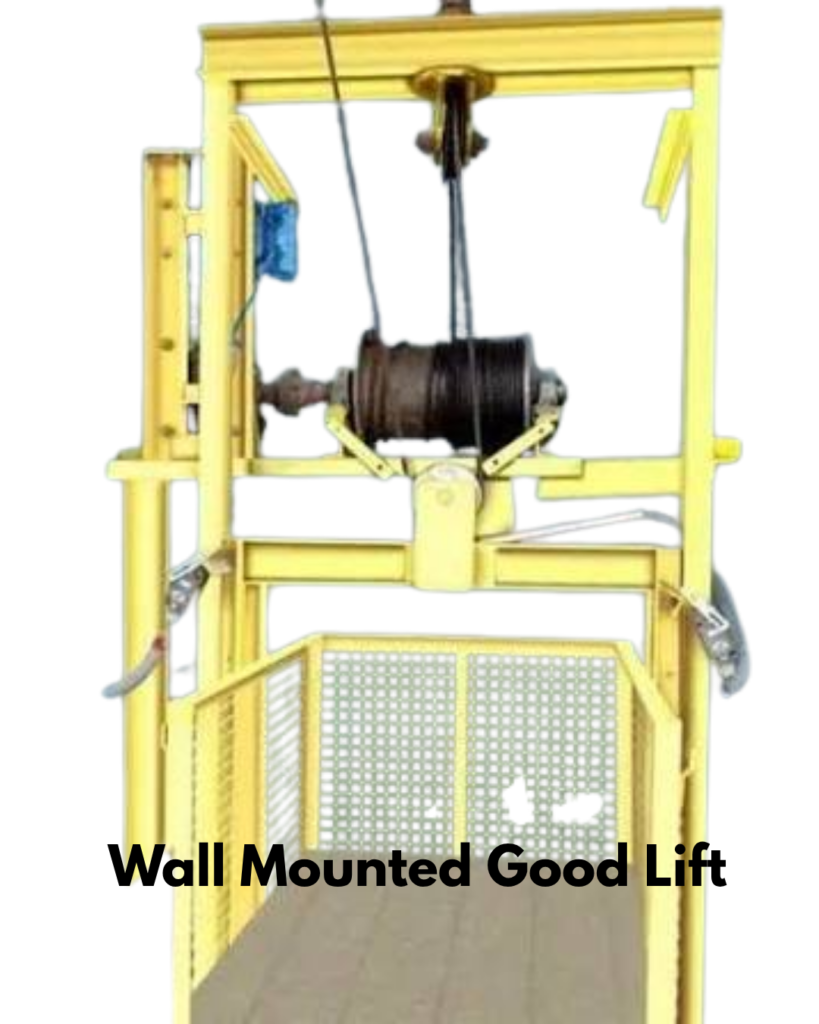
Advantages and Disadvantages of Wall Mounted Goods Lifts
No piece of equipment is perfect for every situation, and we’d rather tell you the trade-offs upfront than have you discover them later.
Advantages:
- Saves significant floor space compared to a fully enclosed shaft lift.
- Faster and often less expensive installation, since it uses an existing wall.
- Smooth, controlled movement with a hydraulic drive.
- Reduces manual lifting injuries and speeds up floor-to-floor movement of goods.
- Can be customized for hygiene, hazardous, or dust-sensitive environments.
Disadvantages:
- Requires a structurally sound wall capable of bearing the mounted load — not every wall qualifies without reinforcement.
- Slightly limited in maximum platform size compared to freestanding shaft lifts, in some building layouts.
- Regular maintenance of hydraulic components is still necessary, just like any hydraulic machinery.
Being aware of these points before installation — rather than after — is exactly the kind of guidance a good manufacturer should walk you through during the site survey stage.
Industrial Applications of Wall Mounted Goods Lifts
The versatility of a wall mounted goods lift is really what keeps it in demand across sectors:
- Warehousing & Logistics: Moving palletized goods between storage levels quickly, which directly improves overall handling efficiency — something we cover in more depth in our related read, How Goods Lifts Improve Warehouse Efficiency.
- Automotive & Manufacturing: Transporting components and sub-assemblies between production floors without disrupting the assembly line.
- Chemical & Pharma: With flameproof motors and stainless-steel platforms, these lifts meet the stricter safety and hygiene expectations of this sector.
- Printing & Paper Stacking: Auto-leveling sensors ensure paper reams and printed stock are handled without misalignment.
- Textile & Garments: Lint-proof panelling keeps fibre buildup away from moving parts, reducing maintenance issues.
- Heavy Engineering: Higher-capacity variants, including our Dual Mast Goods Lift for warehouse setups, handle heavier and bulkier industrial loads with ease.
Facilities operating any kind of vertical material flow should also be mindful of general workplace material-handling safety practices; the U.S. OSHA 1910.176 + Indian safety/legal references is a widely referenced benchmark for aisle clearance, safe stacking, and mechanical handling equipment safety that’s useful context for any industrial buyer, regardless of country.
It’s also worth noting how goods lifts are improving heavy load handling efficiency more broadly — a single well-placed lift can replace multiple manual trips, cut down labour costs, and reduce workplace injuries tied to repetitive lifting.
Conclusion
A wall mounted goods lift isn’t just a convenience — for many Indian manufacturing units, warehouses, and multi-storey facilities, it’s the difference between a smooth, efficient operation and one that’s constantly bottlenecked by manual lifting. Whether you need a wall mounted stacker goods lift for a compact retail backroom or a heavy duty wall mounted goods lift for a busy production floor, the right specification and the right manufacturer make all the difference.
At SRE Liftech Pvt Ltd, we bring ISO 9001:2015 certification, CE compliance, 125% load-tested structural integrity, and a genuinely engaged leadership team led by Mr. Mayur Nagar to every project we take on. If you’re evaluating a wall mounted goods lift supplier in India, we’d be glad to walk you through a free site assessment and a specification tailored to your facility.
Call us at +91 88490 23410, WhatsApp +91 75748 85758, or email sreliftech@gmail.com — our team, based at our Ahmedabad facility, serves clients across Ahmedabad, Surat, Vadodara, Pune, and other Indian industrial hubs.
FAQs
1. What is the load capacity range of SRE Liftech’s wall mounted goods lift?
- Our standard wall mounted goods lift range covers 500 kg to 2,000 kg (2 Tons), which comfortably handles most warehouse pallets, packed cartons, and mid-weight machine parts. If your facility regularly moves heavier loads, we also manufacture higher-capacity Standard Goods Lifts and Dual Mast Goods Lifts that go up to 10 tons — so the right choice really depends on what you’re lifting on a daily basis, not just what’s technically possible.
2. How is a wall mounted goods lift actually fixed to the wall — is it safe for older buildings?
- The platform and mast are secured using heavy expansion chemical anchor fasteners, which bond mechanically and chemically into the wall structure to bear the full working load. Before installation, our team assesses the wall’s load-bearing capacity; if a wall isn’t strong enough on its own, we recommend reinforcement rather than proceeding with a compromised anchoring point. This is a step some low-cost suppliers skip — and it’s exactly where accidents tend to happen.
3. Leaf chain drive vs. hydraulic cylinder — which lifting medium should I choose?
- Both are proven options, and the right one depends on usage pattern:
- Heavy-duty industrial leaf chains are typically preferred for continuous, high-frequency operation where mechanical durability under repeated cycles matters most.
- Hydraulic cylinder drives offer smoother, quieter, and more gradual movement, which is better suited to fragile or precision-sensitive cargo. Our engineers usually recommend the drive type after understanding your daily cycle count and the nature of the goods being moved, rather than defaulting to one option for every project.
4. How fast does the platform travel, and is that speed adjustable?
- The standard travel speed on our wall mounted goods lifts ranges from 60 mm/sec to 90 mm/sec. This range is intentional — fast enough to keep operations efficient, but controlled enough to avoid load swing or spillage, which is a real risk with poorly engineered high-speed lifts.
5. Fully enclosed steel cabin or side mesh enclosure — which is better for my application?
- It depends on what’s being transported and the surrounding environment:
- A fully structured steel plate cabin is better where dust, weather exposure, or product protection is a concern — common in pharma, food, and electronics handling.
- A side mesh enclosure is lighter, more cost-effective, and offers better visibility for supervisors, which many warehousing and logistics setups prefer. We can advise on the better fit once we understand your facility layout and material type.
6. What power supply does a wall mounted goods lift need, and does that affect running cost?
- Our lifts run on a standard 3-Phase 415V, 50Hz AC power supply, which is the norm across Indian industrial and warehouse facilities. Because the hydraulic and chain-drive systems are engineered for efficiency rather than constant high-draw operation, running costs stay predictable and don’t spike compared to similarly rated material handling equipment.
7. Is a wall mounted goods lift safe for daily industrial use, and what makes it different from a cheap local fabrication?
- Yes — provided it’s engineered with proper safety devices, which is exactly where the difference between a certified manufacturer and a local fabricator shows up. Every SRE Liftech Pvt Ltd unit includes overload trip valves, hose-burst protection, door safety interlocks, emergency stop buttons, safety perimeter skirts, and fallback prevention safety cables as standard, not optional extras — and the entire structure is load-tested at 125% of rated capacity before dispatch.
For a free equipment consultation direct enquiries, call +918849023410, or reach the team on WhatsApp at +917574885758. You can also write to sreliftech@gmail.com or visit SRE LIFTECH PVT LTD at Plot No:13, Shreenathji Industrial Estate Part-2, Bakrol Bujrang Road, Bakrol, Ahmedabad, Gujarat – 382430. If you’re comparing an industrial goods lift supplier for an upcoming facility upgrade, a documented site assessment is the most reliable starting point before finalizing specifications.
Get Quote
Need Custom Engineering Specifications?
Consult SRE LIFTECH engineers for custom load capacities, platform dimensions, shaft drawings, and immediate B2B factory pricing.